Monday, October 17, 2011

Grant to address American Indian teen pregnancy

Source: KSFY

The University of South Dakota and the nonprofit Sanford Research have been awarded a $1.5 million grant to address teen pregnancy rates among American Indians.
Teen pregnancy rates among Native Americans are four times higher than those for the rest of the state's population.
The grant from the National Institute of Minority Health and Health Disparities will be used to research the reasons why and develop a prevention program. Amy Elliot with Sanford Research says the program would be for reservation and urban Indians throughout the Northern Plains.
Helping with the project are the University of Minnesota, South Dakota Urban Indian Health and the Great Plains Tribal Chairmen's Health Board.

Copyright 2011 The Associated Press. All rights reserved. This material may not be published, broadcast, rewritten or redistributed.

Wednesday, October 5, 2011

October Math Meeting

Structures
K-1
Ten Frame
2-3
Base Ten System
4-5
Array - creation and decomposition
Multiplication/Division - Quick Images - groupings
Expressions


7E
Elicit
Engage
Explore
Explain
Elaborate
Evaluate
Extend

Connect math with the world around us

I have _7 bananas______ |||| My friend gave me _____8 bananas______
I have ____15 bananas___________.

Thursday, September 8, 2011

The joys of school lunch

9-7-11
Male Student: "Hey, what are we eating today?"
Female Student: "I don't know. Probably over cooked meat."

Smart Exchange

Loy from Spring Creek had this site posted on Facebook. There are a ton of Smart Board activities listed here. Enjoy! 

Smart Exchange


Saturday, August 20, 2011

EDAD 715: Administrator and Instructional Supervision

Melody Schopp, PhD

Four Goals of Education: 
1. Career Development - help kids be focused on careers and life
2. Effective Teachers & Leaders
3. Quality Standards & Resources
4. Healthy Kids
  • Physical and Emotional
  • throwing in physical activity throughout the day
Charlotte Danielson Framework are the set of standards the State of South Dakota has adopted.
  • Looks at the teaching not the teachers
  • Courses and Book Studies over the next few years offered to the state
FFT - Framework for Teaching

What Does "a Framework for Teaching" Mean?
  • A description of the teacher responsibilities that promote student learning.
  • A definition of what teachers should know and be able to do in the exercise of their profession, based on research and best practice
  • A common language that allow opportunities for educators to discuss good teaching.
  • A structure designed to address the complexities of teaching applicable to all practitioner levels from novice through accomplished.
The "Wow" Factor
If you were to observe an excellent teacher, either in the classroom or another professional setting, what might you see or hear that would caouse you to think that you were in the presence of an expert?
What would make you think, "wow, this is good! If I had a child this age, This is the class I would want to choose."

Write one idea per sticky note.

A Framework for Teaching" The Domains
1. Planning and Preparation
2. The Classroom Environment
3. Instruction
4. Professional Responsibilities.

Seven Common Themes throughout all of the Domains
  • Equity
  • Cultural Sensitivity
  • Hight Expectations
  • Developmentatl appropriateness
  • Accommodating individual needs
  • Appropriate use of technology
Evidence: A Reporting of the Facts
  • Evidence may include statements, actions or behaviors
  • Evidence may also include artifacts prepared by the teacher, students, or others
  • Evidence is not personal opinion or bias. It is selected though the observance and or teachers use of professional judgment.
Teaching is so hard that it is never perfect. - Charlotte Danielson

Features of the Framework
  • comprehensive
  • grounded in research
  • public
  • generic
  • coherent in structure
  • independent...


Summary of Framework
  • A research-based definition of good teaching
  • A road-map to, and for navigating through, the complex territory of teaching
  • A framework for novice-level practitioners, through accomplished teaching

Uses of Framework
  • Teacher preparation
  • Supervising student teachers
  • Teacher recruitment and hiring
  • Mentoring beginning teachers
  • Structuring professional development
  • Evaluating teacher performance


Wednesday, August 17, 2011

Tests Show 1 In 4 U.S. Students Set For College; Wide Gap For Minorities

Only 1 in 4 U.S. high school graduates who took the 2011 ACT college entrance exam scored high enough to be deemed ready for college-level courses in all four of the test's subject areas, according to the company that designs the tests. Story continues here...


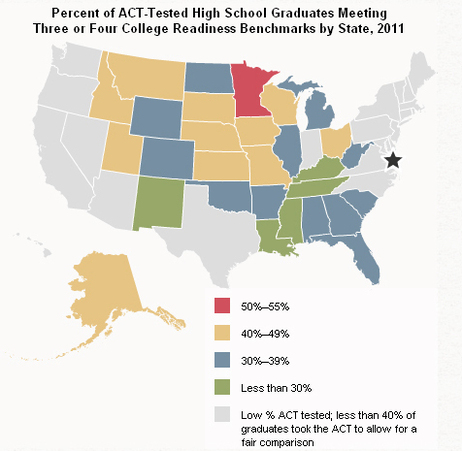
Out of the 29 states in which at least 40 percent of graduates took the ACT, only Minnesota had more than half of its students meet at least three college-readiness benchmarks.

Out of the 29 states in which at least 40 percent of graduates took the ACT, only Minnesota had more than half of its students meet at least three college-readiness benchmarks.

Friday, August 12, 2011

Atlanta's Schools Work Through Cheating Scandal

by Kathy Lohr
August 10, 2011
About 48,000 students headed back to school this week in the Atlanta Public Schools and there's a lot of work ahead — not just for the students, but for the whole district. It's recovering from a scandal that involved widespread cheating on student tests. Nearly 200 teachers and staff have been implicated at about half of the district's schools.
The district downplayed reports that showed a huge number of incorrect answers on student achievement tests were changed, so state investigators got involved. Just last month, Governor Nathan Deal released a 400-page report that detailed unethical behavior, and a climate of fear and intimidation.
"The report's findings are troubling, but I am encouraged that this investigation will bring closure to the problems that existed in the Atlanta Public Schools and restore the focus on students and the classroom," Gov. Deal said at a press conference. Story continued here...

Teachers Feeling 'Beat Down' As School Year Starts

by Claudio Sanchez
As students prepare to begin another school year, their teachers are hopping mad. They're facing layoffs and deep budget cuts and many say they're tired of being blamed unfairly for just about everything that's wrong in public education. They're so mad that many are bypassing their unions and mounting a campaign of their own to restore the public's faith in their profession.
Betsy Leis, a middle school teacher in Florida, is one of these angry teachers.
"I give my heart and my soul to every single student in my classroom and all I see on the news is that we aren't doing our job. We're constantly beat down. That's why I'm angry," Leis says. "I don't make any money and part of me is OK with that because I don't do it for the money."
And it's not enough that people don't appreciate teachers, they've become punching bags, says Claudia Rueda-Alvarez, a high school counselor in Chicago.
She says if people believe this country is going down the tubes, why don't they single out the people on Wall Street who are still getting million dollar bonuses? Story continued here...

Thursday, August 11, 2011

Soft Schools Website

Soft School

Math Investigations Thursday

Math Investigations Thursday - Dana Brown

Estimating Sums

Giving students problems:
  • give a purpose for learning
  • problem to work on
  • wait time
  • partner share
  • share out
Landmark or Friendly Numbers

How students solve Sticker Problems (addition and subtraction):
  • 100s chart
  • open number line

Wednesday, August 10, 2011

Math Investigations Wednesday

Math Investigations - Dana Brown

How do we use data - 

  • Developmental data for children ex. 75 percentile
  • sports
  • testing
  • weather
  • running
  • voting/election results
  • tracking crime statistics
How many years have you been teaching?
It is important to define the question...so you gather the correct data.
Redefined...How long have you been employed by a school district?
Keep students focused on the data...on the purpose of the data...There's 5 X's on 10. No there are 5 people who have taught for 10 years.

Using fractions is a good way to present the data to students:
1/3 of our group has taught 5 years or less
about 1/2 of the group has taught between 10 and 20 years
about 1/2 of the group has taught 12 years or less

median: middle value of the data when the data is put in order
Visual way to show the median: line 11 people up and point out the center. The median can be in the center of two points
1/2 the teachers have taught 16yrs or less and 1/2 the teachers have taught 16 years or more
 Range: the difference between the highest value and the lowest value in a set of data.
Mode: the value that occurs most often in a set of data
Outlier: a piece of value that has an unusual value, much lower or much higher
Median: the middle value of the data when all the data are put in order


What occupation would you choose if you weren't a teacher?


Tuesday, August 2, 2011

You need to make mistakes to get ahead

By Alina Tugend, Special to CNN
August 2, 2011 8:45 a.m. EDT


Editor's note: Alina Tugend, author of Better By Mistake: The Unexpected Benefits of Being Wrong, has been a journalist for nearly 30 years. She lives outside New York City with her husband and their two sons.
(CNN) -- We live in a culture that sends out very mixed messages about mistakes: We're told we learn by making them, but we work mightily to avoid them; that no one's perfect, but goofing-up is bad. So the result is most of us know that we -- as parents, spouses, employers and employees -- are going to make mistakes, but deep down, we feel we shouldn't.
But since, as the old saw goes, "to err is human," how do we work toward accepting mistakes and learn from them, rather than avoiding and denying them? Well, the good news is that there are upsides to making mistakes:
One of the definitions of "to err" is "to wander or stray." Often we make mistakes because we try new things -- we stray from accepted paths. Teflon, penicillin -- these are examples of great discoveries made by mistake. Take a page from Albert Einstein, who said, "Anyone who has never made a mistake has never tried anything new." Continued at CNN...

Building Leadership Teams - Aug. 2

Reconnecting with your Building Leadership Teammates!
Doris Ray & Sue Card

Victoria L. Bernhart - Data Analysis for Continuous School Improvement
http://eff.suchico.edu


1. What types and levels of data can BLTs look at to make school-level improvement decisions?

Systematic -> A logical, structured process of collecting, analyzing to increase understanding of your school's system.

Systemic -> Considers all the processes and procedures that contribute to student learning.

Continuous Improvement -> Done on an ongoing basis - Proactive

From Random Acts of School Improvement to Focused School Improvement

Think-Pair-Share

1. As a BLT, what is your purpose for collecting data at your school?

attendance, to see strengths and weaknesses of students,

2. What TYPES of data do you already collect?

No Child Left Behind, make AYP, AIMSweb, D-Step, DACS, looking at individual

Types of Data

Demographics - Enrollment, Attendance, Drop Out Rate, Ethnicity, Gender, Grade Level - Over time, indicates changes in the context of the school

Perceptions - perceptions of learning environment, values, beliefs, and attitudes, observations - Over time, can tell us about environmental improvements
  • What people think and feel when the enter your school
    • Family walk through
    • Student interviews
    • culture surveys
    • staff surveys
    • grapevine data
    • feedback forms
Student learning - State, district, school and teacher developed assessment, teacher observations - over time, gives us information about student performance on different measures

School Processes - Descriptions of school programs and processes - over time, tells us how classrooms change
  • what went well
  • what didn't go well
  • where it work
  • where it didn't work
  • what you need to do to improve
  • discipline, how? who? where do the most infractions occur
  • Marzano strategies - who? where?

As a BLT...
1. Start a list - an inventory - of the DATA TYPES you already collect.
  • Demographics - attendance, enrollment, mobility of students, gender (number of boys and girls) in each class
  • Perceptions - take students as is, parent walk throughs, district culture surveys, district staff surveys
  • Student Learning - AIMS Web, D-Step, DACS, anecdotal notes, WIDA
  • School Processes - not really
2. What do you notice?
  • Need to work on perceptions and school processes
LEVELS of Data Analysis

  1. Snapshots - ex. enrollment for 09-10 = 2083
  2. Snapshots over time - ex. 2001 to 2010 (10 years) Average number of students enrolled = 2442
  3. Two or more variables within the same type of data - ex. 9th graders 2005-06 school year - average days enrolled: 129/168 and average days absent 30/168
  4. Two or more variables within same type of data over time - ex. 2001-2010 - TCSD: average days enrolled 132/163; average days absent 16/163
  5. Intersection of two types of data - ex. Class of 2009; enrolled as seniors as of May 2009 - 77; Seniors had earned enough credits to graduate = 44
  6. Intersection of two types of data over time - ex. 2001-2010; average number grade 9 = 259; average number of graduates = 65 students
  7. Intersection of three types of data
  8. Intersection of three types of data over time
  9. Intersection of all four types of data
  10. Intersection of all four types of data over time
Levels used at HEDOG

Level 1 - snapshots
Level 5 - intersection of two types of data - test scores and demographics

Data Driven Dialogue
Phase 1: Predict and Ground
Phase 2: Observe
Phase 3. Infer/Question

Monday, August 1, 2011

Transforming the School

Contemporary School Administration by Theodore Kowlaski  - Chapter 14  NOTES
 
Organizational Change

Administrators can usually induce temporary behavior changes (through the promise of rewards or threats of punishment), but unless the basic values and beliefs of teachers and other employees are reshaped, they revert to the routine behaviors once the pressure to change has subsided
  • Defining Change
    • Change is a process. 
    • Change is a medium for adaptation.
    • The only thing that is permanent is change. 
    • Often, changes that occur in schools are not perceptible to the general public
    • Many changes that occur in school generate little attention and produce little conflict. However, attempted transformations of values and practices are a different matter...
  • Change in Educational Institutions
    • Gene Hall and Shirley Hord (2001) offer and explanation as to why schools appear to be both intractable and adaptive. They observed that many education innovations have been "adopted, tired out, and subsequently rejected - only to cycle around and be readopted some years later in a 'new and improved' form"
    • schools are caught in a web of enduring internal and external dilemmas that serve to derali change initiatives
    • The more detrimental internal issues include the following: 
      • Goals -
      • Task structures
      • Hierarchy
      • Professionalism
    • The more detrimental external issues include the following: 
      • Persistence - tensions between protecting the status quo and making adaptations
      • Boundaries - tensions between protecting the integrity of the organization and dealing with environmental uncertainty
      • Compliance - tensions between technical compliance and institutional compliance
    • Educational change has been studied in relation to three key variables: 
      • Change source
      • Change type
      • Time orientation
    • A major difference between external and internal change relates to administrative choices
      • because schools were created and sustained as agencies of social stability, administrators have not been especially encouraged to initiate or support changes that could threaten this role.
Resistance to Change
Resistance to change has been described as "any attempt to maintain the status quo when there is pressure to change"
  • General Resistance
    • schools have developed an institutional character that generally treats change as disruptive and counterproductive
    • Organizational character is perceptible in the following areas:
      • Vision - common understanding of purpose and identity?
      • Fairness - motivational faith in administrators because of trust?
      • Ability - motivational faith in administrators because of knowledge and skills?
      • Distinctive skills - customs? networks of experts? technology?
    • when people inside the school have little or no understanding of the purposes or potentialities of change, they almost always develop high levels of anxiety and resistance
  • Specific Barriers
    • barriers to understanding - pertain to information deficiencies
    • barriers to acceptance - pertain to philosophical or professional incongruity
    • barriers to acting - pertain to human or material resource deficiencies
    • Some of the most common obstacles found in schools:
      • lack of involvement in setting the agenda
      • lack of information about the agenda
      • lack of conviction
      • disenchantment and alienation
      • discontinuity of leadership
      • insufficient time and resources
      • inadequate preparation to deal with the complexity of change
      • ineffective or insufficient use of the professional knowledge base
Change Strategies
Common Strategies that have been used to pursue change:
  1. Empirical-Rational strategies: Employees behave rationally and employees are motivated by self-interests.
    • fails because people do not always act rationally
  2. Normative-reeducative strategies: change requires employees to alter their normative orientations to behavior patters - by exposing employees to new knowledge and skills that will affect values and beliefs
    • have been used extensively in education; however, that does not mean that they have been highly effective.
  3. Power-coercive strategies: most members of the organization are unwilling or incapable of producing change.  Economic or political force must be used.
    • fail because educators resent being forced to do things differently - and the condition of their work environment (e.g. control over the classroom) gives them the power to resist.
Culture Change
The reactionary nature of educators is attributable to several circumstances:
Past practice (shaping role expectations) and limited knowledge about organizational culture and its effects on behavior (creating apprehensions about recreating culture)


Complexity of Culture Change
f
Basic Values and Beliefs
Time Dimensions
Culture and Restructuring

How Shanghai schools beat them all

It appears that no one takes education quite as seriously as the Shanghainese.
Every three years, the Organisation for Economic Co-operation and Development (OECD) administers its worldwide Programme for International Student Assessment (PISA) to measure how well a nation’s education system has been preparing its students for the global knowledge economy. Nations such as South Korea, Finland, and Singapore have traditionally topped the rankings, but, apparently, even they are no match for Shanghai, which shoved the others into lower positions in its very first year of participation in the programme, in 2009.
When I was in Paris last week, I decided to drop in on Andreas Schleicher, the programme’s architect, to get his views on PISA and Shanghai’s education system. Dr. Schleicher, who was recently profiled in the Atlantic Monthly, had some very interesting things to say about both.
According to Schleicher, Shanghai’s education system is distinctive and superior — and not just globally, but also nationally.
Hong Kong, Beijing, and ten Chinese provinces participated in the 2009 PISA, but their results reflected education systems that were still the same-old knowledge acquisition models, whereas Shanghai had progressed to equipping students with the ability to interpret and extrapolate information from text and apply it to real world situations — what we would normally refer to as ‘creativity.’  Twenty-six percent of Shanghai 15 year-olds could demonstrate advanced problem-solving skills, whereas the OECD average is 3 percent.
So how did Shanghai create the world’s best education system? Continued at CNN...

How a Principal Creates a Culture of Consistency


Effective Teaching
by Harry & Rosemary Wong
Special to the Gazette
August 2011 

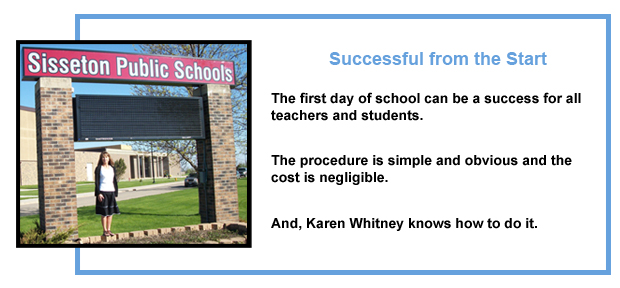
Karen Whitney arrived in Sisseton, South Dakota, three years ago and in her first year as a principal, there were not only 578 office referrals, but 87 inches of snow.  This past year office referrals dropped drastically, with only 193 referrals, and was accompanied with a rise in student achievement.  But, to everyone’s dismay, the snow kept falling! Karen is principal of Sisseton Middle School, a school placed inside the homeland of the Sisseton-Wahpeton Oyate tribe, a branch of the Sioux group of Native Americans, on the Lake Traverse Indian Reservation.  Native Americans make up slightly more than 50 percent of the student population. Continued at this link...

What do students already know?

By Mary Bigelow

Bookmark and Share
 
Last year, I started giving pretests at the beginning of each unit. The students were upset because they didn’t know many of the answers, even though I explained I didn’t expect them to know everything and the pretest wouldn’t count as a grade. Are there other ways to find out what students know about a topic?
–Cheri, Bangor, Maine

One of the most important factors influencing students’ learning is not the activities you plan or the materials you use but what students already know about a topic. In her recent Edutopia blog Are You Tapping into Prior Knowledge Often Enough in Your Classroom? Rebecca Alber describes the research on the value of accessing the knowledge, skills, and experiences students bring to a learning unit. Continued at link...

Balanced Literacy ~ August 1-2, 2011

Making the Most and Getting the Best Using A Balanced Literacy Approach

Black Hills State University Professors
Faye LaDuke-Pelster - - Faye.LaDuke@bhsu.edu
Sue McGrath - - Sue.McGrath@bhsu.edu

Comprehensive Literacy Framework (Balanced Literacy) - handout

  • Starts with Assessment - DRA, Running Records, DACS, AIMSweb, anecdotal notes
  • Read Aloud - teacher reads for enjoyment to students
    • enjoyment
    • modeling comprehension strategies
    • think alouds
    • expose them to different types of text
  • Shared Reading - 
    • ex. Social Studies and Science, highlighting text, big books, poetry, revisiting text with purposes
  • Guided Reading - small group instruction
    • ex. literature circles
    • focusing on needs (moving students in and out depending on need)
    • should be done once or twice a week, the other days should be conferencing with students one-on-one
    • the first six weeks of school should be focused on learning about students (conference, observe students)
    • establishing routines
  • Independent Reading - children have to practice, uninterrupted chunks of time to read
    • practice, practice, practice
    • not happening at home
    • have to teach students how to read independently
    • gives us time to each when students are reading
  • Independent Writing - student practices writing
    • practice
    • assessment
    • conferring with students
    • students should have choice over what they want to write (CHOICE)
    • have students keep a list of ideas in their book that they could write about
  • Guided Writing - small group instruction
    • work on a specific skill, groups based on needs
  • Interactive Writing - share the pen with students
    • modeling
  • Shared Writing - teacher is the scribe

The components of phonemic awareness, phonics, oral language, and literature circles/discussions are embedded in the above components.

Richard Peck - A Long Way from Chicago

Gradual Release of Responsibility (GRR) to Conquer Classroom Management - handout

Steps:
  1. Demonstration (teacher)
  2. Shared Demonstration (teacher)
  3. Guided Practice (student)
  4. Independent Practice (student)


Examples
  • Transitioning 
    • whistle
    • clapping
    • using music
  • Practice! Practice!
    • share practice
    • guide practice
The Five Pillars of Effective Reading Instruction - National Reading Panel (2000)
  • phonemic awareness
  • phonics
  • fluency
  • vocabulary
  • comprehension
Skimming and Scanning
Skimming and Scanning requires a reader to look quickly and find the most important features and information in a text.

Comprehension from the Ground UpSharon Taberski
Ground Up link
Chapter 1: What Really Lies at the Heart of Comprehension

The Five Pillars of Effective Reading Instruction - National Reading Panel (2000)

  • phonemic awareness
  • phonics
  • fluency
  • vocabulary
  • comprehension
New Thinking on the Pillars of Reading
 (Experiences and Skills that cultivate children's comprehension.)

COMPREHENSION (over all) Students are also inferring as they read all the time.
  • Accurate Fluent Reading
  • Background Knowledge
  • Oral Language and Vocabulary
  • Reading-Writing Connections
  • Repertoire of strategies 
Time to Talk
Time to Write
Time to Read

Fundamental needs of Children:
  • Children need us to be their advocates.
    • "It is simply wrong to withhold the precious time students need to delight in reading books from their just-right bag that will help them consolidate the skills and strategies they're trying to acquire because we've used up all our time with lengthy whole-group instruction."
  • Children need ample opportunities to read widely and across genres, to write texts for others to comprehend, and to engage in thoughtful conversation.
    • If we want children to develop as readers, they must have abundant opportunities to write texts for others to comprehend.  
  • Children need to read accurately and fluently with comprehension.
    • We want students to read words accurately with appropriate speed, intonation, and emphasis so that they understand what they're reading.
  • Children need to acquire background knowledge to bring to texts they read.
  • Children need to extend their oral language and vocabulary, and capitalize on how they enhance reading comprehension.
  • Children need to appreciate not only how to reading impacts writing, but how their experiences as writers enables them to adopt an insider's stance as they read.
  • Children need to acquire a repertoire of meta-cognitive strategies to help them navigate difficult texts and reconstruct meaning when it breaks down. These strategies should be presented in a developmentally appropriate and systematic way throughout the elementary grades.
Comprehension from the Ground UpSharon Taberski

What Is a Repertoire of Strategies?
  • setting a purpose for reading
  • accessing and using prior knowledge
  • considering text structure
  • asking questions
  • visualizing
  • summarizing to determine importance
Reader's Workshop 3 steps
  • Community meeting
    • booktalk
    • mini-lesson
  • Independent Reading
    • small group instruction
    • conferences
    • literature circles
  • Group Share (or share with a buddy)
    • What did you learn about yourself as a reader today?
    • Opportunity for holding students accountable for independent work
      • how many pages did they read?
      • types of genres 
It's All About Comprehension Video Notes: Sharon Taberski
Mini Lesson
  • book basket with book of the topic you are studying
  • folders with word lists (word banks) that are in the reading
  • folders with pictures and information about topics
  • don't answer questions of students but talk to them discovering their answers
Reading Conference
  • ask questions of the student about their reading
    • can talk to you about your reading
    • help you with your reading
  • folder with a note book
  • work on a couple of nonfiction, and one fiction. Don't want students to get their fiction stories mixed up
  • Help with strategies - main events sheet (title, author)
  • Commit to one book, stick with it to the end

Sunday, July 31, 2011

Friday, July 29, 2011

SDI +

This spring I was asked to become a member of He Dog's Building Leadership Team or BLT. The past couple of days I attended the South Dakota Incentives Plus Summer Institute in Rapid City with my BLT group. Teamwork and group work was the topic for both days. First, we talked about the qualities of good groups and then we discussed the Five Dysfunctions of A Team.

DAY ONE

The leadership team from Horace Mann Elementary in Rapid City presented on how they have been able to change the culture of their school and increase their students test scores. They have adopted the mantra "Every Student, Every Minute, Every Day." It was great to hear how they feel teamwork and positivity has changed their school. The topic also ties very nicely to what I've been reading in Theodore J. Kowalski's Contemporary School Administration. Kolwalski talks about milieu (people and relationships), organization (curriculum and schedules), ecology (buildings and supplies), and culture (values, beliefs, and norms). These components of school climate need to be in harmony for a school to be effective.

***All the presentations are located at the South Dakota Incentives Plus website.***

Notes from the Horace Mann Elementary Presentation: 

"It's all of our jobs to help every single student in our building." 
- Mr. Danny Janklow, Horace Mann Elementary Principal

Steps for Change: 

All about students, not the staff, except to use the talent available to impact the children in a positive and productive way.

"This is about children. It's not about adults." 
- Mr. Danny Janklow

What's your philosophy?

  • Every Child, Every Minute, Every Day!
  • Complete and total respect for self and others
  • Negative comments and behaviors are confronted and not tolerate
What are the five trends in schools with the greatest gains in achievement and equity? (from the Learning Leader by Douglas Reeves)
  1. They embrace holistic accountability.
    • Accountability includes the actions of adults, not merely the test scores of students. 
  2. These schools include consistent nonfiction writing assessments in every subject. 
    • Writing includes: editing, collaborative scoring, constructive teacher feedback (immediate) and rewriting
    • When students write, they are engaged in thinking, reasoning and analysis.
  3. These schools use frequent common assessments. 
    • Assessments, in contrast to tests: 
      • are formative
      • are provided throughout the school year
      • are designed to improve teaching and learning
      • accompanied by immediate, relevant feedback
  4. Effective Schools and their staffs use immediate and decisive interventions.
  5. Constructive use of data

"It's everyone's responsibility. Ask yourself these questions: What is your goal? Why would you do that? How are you going to work together to do the best for the kids?"
- Mr. Danny Janklow

All staff expectations: 
NO EXCUSES!!!
"Are you telling me you don't want to do your job or you can't do your job?"
- Mr. Danny Janklow

Team work information: 

What makes teams effective?
  • communication
  • shared decision making
  • norms
  • buy in
  • set roles
  • consistency
  • a mission for the group
  • transparency
  • willingness to listen and compromise
We were asked to reflect on the teams in which we are a member of and teams we are leaders of then asked where is my primary allegiance? This is a question that all group members must ask themselves.

DAY TWO

TIE Deputy Director John Swanson presented on the Five Dysfunctions of a Team. The Five Dysfunctions of A Team was written by Patrick Lencioni.

The Five Dysfunctions of a Team: 

  1. Absence of Trust
  2. Fear of Conflict
  3. Lack of Commitment
  4. Avoidance of Accountability
  5. Inattention of Results
1. Absence of Trust
  • Can we trust people to be real all the time?
  • Do we have a willingness to be vulnerable?
  • Can we admit when we don't understand how to do something?
Building Trust
  • Personal Histories
  • Behavioral Profiles
  • Shared Experiences
2. Fear of Conflict 

Mastering Conflict
  • Mining for conflict
  • Real Time Permission 
    • giving people the right to be disagreeable
    • confronting the issue right away
  • Setting the Hook
3. Lack of Commitment
  • You agree and then commit to what you are doing.

4. Avoidance of Accountability
  • Call out people's deficiencies or unproductive behaviors
  • It's harder to stand up to our friends than our enemies.
This reminded me of what Dumbledore says to Neville Longbottom at the end of Harry Potter and the Chamber of Secrets movie:
"There are all kinds of courage. It takes a great deal of courage to stand up to our enemies, but just as much to stand up to our friends."

5. Inattention of Results
  • Focusing on Results
    • Establish a Scoreboard
    • Distractions: EGO, Career Advancement, Money, "My" Department
Where is my primary intelligence?

~~The Abilene Paradox~~
  • The tendency of groups to make decisions that the individuals of the group do not support.
  • Don't make a decision that you believe in, but what you think others believe in -- Group Think

Sunday, July 24, 2011

Tuesday, May 31, 2011

Teacher sites

http://www.marzanoresearch.com/site/

http://www.marzanoresearch.com/Free_Resources/itembank.aspx

http://www.solution-tree.com/Public/Main.aspx

Tuesday, April 5, 2011

TIE Monday Morning

These are my notes from Monday and Tuesday. I'll come back and add some detail later. :-)

Meg Ormiston

Video games - really hard problem solving
Cool gadget -- Belkin - $7 to 10 Rockstar
The 1980s called they want their worksheets back.

http://www.ipodsibilities.com/iPodsibilities/Home.html
http://megormi.wikispaces.com/TIE2011

Blogging Across the Curriculum: Science Classes, Literature Circles, and in a School Library
Allison Radermacher, Krista McMiller & Tyler Hoffman - Ellendale Public School

Literature Circles - Don't post questions, just let kids ask questions

Quest for Success Camelot Intermediate School, Brookings, SD
Strengthening foundations and igniting a love of learning as students pursue a lifelong quest for success

Camelog Letter Program - Students identify a need and create a plan

Visual Thinking Strategies
VTS is a school curiculum and teaching method that uses art to develop critical thinking, communication and visual literacy skills

What is going on in this picture?
What do you see that makes you say that?
What else can you find?
15 minute session - teacher just points out what student is talking about

Garden Club
 - project based learning
Dave Fiedler, principal

What makes a healthy 4th grader?
What makes a healthy fourth grader?
Write a standard, and a rubric

PBL Driving Question: Who was a key person, or what was a key even during the American Revolution? List standard

every student has a flashdrive

Lewis and Clark Documentary - Using Photostory
You can change a Power Point into a photostory

Geometry collage
Math project: Cemometry collage
Create a collage of geometric shapes in publisher

http://st005.k12.sd.us/

Political Cartoons

SD Poetry
tarheelreader.org

http://www.pbs.org/wgbh/nova/vikings/runes.html

http://www.archives.gov/exhibits/charters/declaration_sign.html

Amazing Animals - teaches powerpoint

Youblisher.com - anything you can PDF can be put in Youblisher   South Dakota ABC book

Rushton Hurley (afternoon)
tinyurl.com/RH-SDTIE11
xrl.us/NVnews
twitter.com/rushtonh

www.google.com
Calculator
currency converter
can check flight info
weather57566
movies(zipcode)

Google Translate
Google Advance search
Google Book
http://librivox.org/
http://www.jamendo.com/en/
Using flicker to teach vocabulary
http://www.googleartproject.com/
http://www.khanacademy.org/
http://www.geogebra.org/cms/
http://www.nextvista.org/
http://www.google.com/squared
http://zamzar.com/
shorewood lip dub
http://www.thinkfinity.org/

Vicki Sterling and Don Wiken (DSU)
Xpeditions - http://www.nationalgeographic.com/expeditions/

http://www.econedlink.org/

http://illuminations.nctm.org/
http://www.polleverywhere.com/
http://www.readwritethink.org/
http://www.readwritethink.org/parent-afterschool-resources/games-tools/alphabet-organizer-a-30179.html
http://www.readwritethink.org/classroom-resources/student-interactives/fact-fragment-frenzy-30013.html
http://www.readwritethink.org/classroom-resources/student-interactives/crossword-puzzles-30068.html
http://www.readwritethink.org/classroom-resources/student-interactives/literary-elements-30011.html
http://www.readwritethink.org/classroom-resources/lesson-plans/book-report-alternative-examining-236.html
http://www.readwritethink.org/parent-afterschool-resources/games-tools/character-trading-cards-a-30181.html
http://artsedge.kennedy-center.org/educators.aspx
http://www.sciencenetlinks.com/interactives/powerup.html
http://bodybrowser.googlelabs.com/

Tuesday
Steve Hargadon   http://www.futureofeducation.com/
John Taylor Gatto   http://www.johntaylorgatto.com/

Kevin Honeycutt
http://kevinhoneycutt.org/
http://sketchup.google.com/
http://www.inglobetechnologies.com/en/new_products/arplugin_su/info.php
How much is this costing the district? It's free our teacher found it, you're welcome.
Kim Herron kheron@usd448.com
I was kicked out for thought lifting.
kids need to learn to love to learn L2L2L
innovation - thinking of something that doesn't exsist we learn more from failure than success
http://tinyurl.com/apollol3lesson
http://cosmospherelearningnetwork.ning.com
http://tinyurl.com/openworldproject
ouropenworldproject.com
we should be benolvent pioneers on the frontier
classroom 2.0

Sunday, April 3, 2011

TIE Conference Update

Here is an update from Sunday at the TIE Conference -

This afternoon I went to an In-Depth Session at Hill City Elementary titled Elementary One to One Laptops - How to Implement, Organize and Excite Students About Learning In a One to One Classroom. The class was led by Sharla Steever & John Hohm.

The workshop focused on ideas to use in classrooms where the student to computer ratio is 1:1.

John Hohm talked about SharePoint. SharePoint is free through the South Dakota K-12 site. All South Dakota educators should have a log in to the K12 site. (Unfortunately, I know I have one, but I have no idea what it is. I stopped logging into it when I got my TCSD address. I emailed the State help site to find out what it is.)

SharePoint can be used like a website, but it's only accessible to those with permission. You can also load documents on the site. Students can download them, work on a project, and then upload the completed document. Sharla Steever talked about having "paper free" assignments. They use tablet computers, so she can open an assignment and use her stylus to grade right on the document. Very cool!
You can request a SharePoint Site at the link below.
Members Site - State of South Dakota

Sharla said the keys to using one-to-one computers is starting small, having a routine and setting goals. She said that she has done many tech projects that have failed, but her students and herself learn from the experience. She suggested teaching kids to troubleshoot. She has tables in her room and she has a "tech helper" at each of the tables. These students helped the other students before they come to her with their questions.

Sharla talked about the following sites:
  • IXL - A math site that requires a subscription
  • Math Flash Cards - These are actually downloaded on to each student's computer. No Internet needed after they are downloaded. Sharla said she has the kids make an Excel file to record their daily scores. They practice for a minute on each - addition, subtraction, multiplication, and division. After they have recorded a number of days, they make a graph in Excel to see their progress. (I'm not sure if these will work on a MAC.)
Another cool idea from Sharla - They have Math Minutes and Ranger Reading. Students do math and read for 15 minutes a night. (They get to take their computers home.) They chart this info. Students that reach the goal number get to go on a special math field trip. I think this is a really great idea. It would be interesting to explore how this could be used to encourage students to read at home in the evenings.
More Sharla sites:
  • Delicious - Delicious puts your bookmarks online and then you can share them with others. I use this program myself, although I don't share all my sites publicly. It's a great way to back up your bookmarks in case your computer crashes. It's also a good way to share bookmarked sites with your coworkers.
  • Here is a cool language arts site for upper elementary grades.
  • Achievement Series - Sharla uses this periodically to assess her students to see what they need to be working on in reading and math. It is from the same company that does the DACS testing. You need a log in to use this site. Do we have access to this site?
  • Typing Pal - A site to practice typing skills. Needs a subscription.
  • Type With Me - VERY COOL! A word processing program that allows more than one student to work on the file at the same time. Great for doing group research.
  • Create your own Google Search - Want your students to research a certain topic, but you want them to only use certain sites. Create your own Google search.  You do need a Gmail address.
  • Diigo - Sharla didn't talk about this one, but it was suggested by one of the teachers in attendance. It lets you highlight and sticky note pages and they stay there when your students visit those pages. 
That was just the afternoon session. The key note speakers were Rushton  Hurley and Ken Shelton. I'll blog about them in the AM. It was a good day.

Wednesday, March 16, 2011