It appears that no one takes education quite as seriously as the Shanghainese.
Every three years, the Organisation for Economic Co-operation and Development (OECD) administers its worldwide Programme for International Student Assessment (PISA)
to measure how well a nation’s education system has been preparing its
students for the global knowledge economy. Nations such as South Korea,
Finland, and Singapore have traditionally topped the rankings, but,
apparently, even they are no match for Shanghai, which shoved the others
into lower positions in its very first year of participation in the
programme, in 2009.
When I was in Paris last week, I decided to drop in on Andreas
Schleicher, the programme’s architect, to get his views on PISA and
Shanghai’s education system. Dr. Schleicher, who was recently profiled in the Atlantic Monthly, had some very interesting things to say about both.
According to Schleicher, Shanghai’s education system is distinctive and superior — and not just globally, but also nationally.
Hong Kong, Beijing, and ten Chinese provinces participated in the
2009 PISA, but their results reflected education systems that were still
the same-old knowledge acquisition models, whereas Shanghai had
progressed to equipping students with the ability to interpret and
extrapolate information from text and apply it to real world situations —
what we would normally refer to as ‘creativity.’ Twenty-six percent of
Shanghai 15 year-olds could demonstrate advanced problem-solving
skills, whereas the OECD average is 3 percent.
So how did Shanghai create the world’s best education system? Continued at CNN...
Monday, August 1, 2011

How a Principal Creates a Culture of Consistency
Effective Teaching
by Harry & Rosemary Wong
Special to the Gazette
August 2011
Special to the Gazette
August 2011
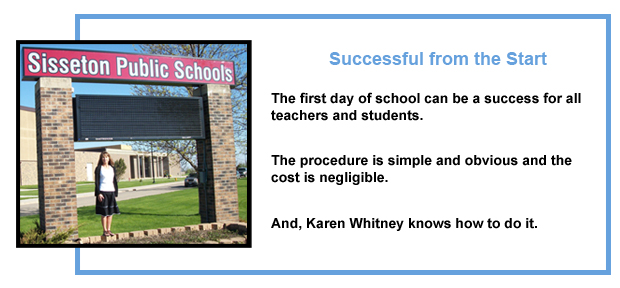
Karen Whitney arrived in
Sisseton, South Dakota, three years ago and in her first year as a
principal, there were not only 578 office referrals, but 87 inches of
snow. This past year office referrals dropped drastically, with only
193 referrals, and was accompanied with a rise in student achievement.
But, to everyone’s dismay, the snow kept falling! Karen is principal of Sisseton Middle School, a
school placed inside the homeland of the Sisseton-Wahpeton Oyate tribe,
a branch of the Sioux group of Native Americans, on the Lake Traverse
Indian Reservation. Native Americans make up slightly more than 50
percent of the student population. Continued at this link...
What do students already know?
July 30, 2011


Last year, I started giving pretests at the beginning of each unit. The students were upset because they didn’t know many of the answers, even though I explained I didn’t expect them to know everything and the pretest wouldn’t count as a grade. Are there other ways to find out what students know about a topic?
–Cheri, Bangor, Maine
One of the most important factors influencing students’ learning is not the activities you plan or the materials you use but what students already know about a topic. In her recent Edutopia blog Are You Tapping into Prior Knowledge Often Enough in Your Classroom? Rebecca Alber describes the research on the value of accessing the knowledge, skills, and experiences students bring to a learning unit. Continued at link...
Balanced Literacy ~ August 1-2, 2011
Making the Most and Getting the Best Using A Balanced Literacy Approach
Black Hills State University Professors
Faye LaDuke-Pelster - - Faye.LaDuke@bhsu.edu
Sue McGrath - - Sue.McGrath@bhsu.edu
Comprehensive Literacy Framework (Balanced Literacy) - handout
The components of phonemic awareness, phonics, oral language, and literature circles/discussions are embedded in the above components.
Richard Peck - A Long Way from Chicago
Gradual Release of Responsibility (GRR) to Conquer Classroom Management - handout
Steps:
Examples
Skimming and Scanning requires a reader to look quickly and find the most important features and information in a text.
Comprehension from the Ground Up - Sharon Taberski
Ground Up link
Chapter 1: What Really Lies at the Heart of Comprehension
The Five Pillars of Effective Reading Instruction - National Reading Panel (2000)
(Experiences and Skills that cultivate children's comprehension.)
COMPREHENSION (over all) Students are also inferring as they read all the time.
Time to Write
Time to Read
Fundamental needs of Children:
What Is a Repertoire of Strategies?
Mini Lesson
Black Hills State University Professors
Faye LaDuke-Pelster - - Faye.LaDuke@bhsu.edu
Sue McGrath - - Sue.McGrath@bhsu.edu
Comprehensive Literacy Framework (Balanced Literacy) - handout
- Starts with Assessment - DRA, Running Records, DACS, AIMSweb, anecdotal notes
- Read Aloud - teacher reads for enjoyment to students
- enjoyment
- modeling comprehension strategies
- think alouds
- expose them to different types of text
- Shared Reading -
- ex. Social Studies and Science, highlighting text, big books, poetry, revisiting text with purposes
- Guided Reading - small group instruction
- ex. literature circles
- focusing on needs (moving students in and out depending on need)
- should be done once or twice a week, the other days should be conferencing with students one-on-one
- the first six weeks of school should be focused on learning about students (conference, observe students)
- establishing routines
- Independent Reading - children have to practice, uninterrupted chunks of time to read
- practice, practice, practice
- not happening at home
- have to teach students how to read independently
- gives us time to each when students are reading
- Independent Writing - student practices writing
- practice
- assessment
- conferring with students
- students should have choice over what they want to write (CHOICE)
- have students keep a list of ideas in their book that they could write about
- Guided Writing - small group instruction
- work on a specific skill, groups based on needs
- Interactive Writing - share the pen with students
- modeling
- Shared Writing - teacher is the scribe
The components of phonemic awareness, phonics, oral language, and literature circles/discussions are embedded in the above components.
Richard Peck - A Long Way from Chicago
Gradual Release of Responsibility (GRR) to Conquer Classroom Management - handout
Steps:
- Demonstration (teacher)
- Shared Demonstration (teacher)
- Guided Practice (student)
- Independent Practice (student)
Examples
- Transitioning
- whistle
- clapping
- using music
- Practice! Practice!
- share practice
- guide practice
- phonemic awareness
- phonics
- fluency
- vocabulary
- comprehension
Skimming and Scanning requires a reader to look quickly and find the most important features and information in a text.
Comprehension from the Ground Up - Sharon Taberski
Ground Up link
Chapter 1: What Really Lies at the Heart of Comprehension
The Five Pillars of Effective Reading Instruction - National Reading Panel (2000)
- phonemic awareness
- phonics
- fluency
- vocabulary
- comprehension
(Experiences and Skills that cultivate children's comprehension.)
COMPREHENSION (over all) Students are also inferring as they read all the time.
- Accurate Fluent Reading
- Background Knowledge
- Oral Language and Vocabulary
- Reading-Writing Connections
- Repertoire of strategies
Time to Write
Time to Read
Fundamental needs of Children:
- Children need us to be their advocates.
- "It is simply wrong to withhold the precious time students need to delight in reading books from their just-right bag that will help them consolidate the skills and strategies they're trying to acquire because we've used up all our time with lengthy whole-group instruction."
- Children need ample opportunities to read widely and across genres, to write texts for others to comprehend, and to engage in thoughtful conversation.
- If we want children to develop as readers, they must have abundant opportunities to write texts for others to comprehend.
- Children need to read accurately and fluently with comprehension.
- We want students to read words accurately with appropriate speed, intonation, and emphasis so that they understand what they're reading.
- Children need to acquire background knowledge to bring to texts they read.
- Children need to extend their oral language and vocabulary, and capitalize on how they enhance reading comprehension.
- Children need to appreciate not only how to reading impacts writing, but how their experiences as writers enables them to adopt an insider's stance as they read.
- Children need to acquire a repertoire of meta-cognitive strategies to help them navigate difficult texts and reconstruct meaning when it breaks down. These strategies should be presented in a developmentally appropriate and systematic way throughout the elementary grades.
What Is a Repertoire of Strategies?
- setting a purpose for reading
- accessing and using prior knowledge
- considering text structure
- asking questions
- visualizing
- summarizing to determine importance
- Community meeting
- booktalk
- mini-lesson
- Independent Reading
- small group instruction
- conferences
- literature circles
- Group Share (or share with a buddy)
- What did you learn about yourself as a reader today?
- Opportunity for holding students accountable for independent work
- how many pages did they read?
- types of genres
Mini Lesson
- book basket with book of the topic you are studying
- folders with word lists (word banks) that are in the reading
- folders with pictures and information about topics
- don't answer questions of students but talk to them discovering their answers
- ask questions of the student about their reading
- can talk to you about your reading
- help you with your reading
- folder with a note book
- work on a couple of nonfiction, and one fiction. Don't want students to get their fiction stories mixed up
- Help with strategies - main events sheet (title, author)
- Commit to one book, stick with it to the end
Sunday, July 31, 2011
Friday, July 29, 2011
SDI +
This spring I was asked to become a member of He Dog's Building Leadership Team or BLT. The past couple of days I attended the South Dakota Incentives Plus Summer Institute in Rapid City with my BLT group. Teamwork and group work was the topic for both days. First, we talked about the qualities of good groups and then we discussed the Five Dysfunctions of A Team.
DAY ONE
The leadership team from Horace Mann Elementary in Rapid City presented on how they have been able to change the culture of their school and increase their students test scores. They have adopted the mantra "Every Student, Every Minute, Every Day." It was great to hear how they feel teamwork and positivity has changed their school. The topic also ties very nicely to what I've been reading in Theodore J. Kowalski's Contemporary School Administration. Kolwalski talks about milieu (people and relationships), organization (curriculum and schedules), ecology (buildings and supplies), and culture (values, beliefs, and norms). These components of school climate need to be in harmony for a school to be effective.
***All the presentations are located at the South Dakota Incentives Plus website.***
Notes from the Horace Mann Elementary Presentation:
Steps for Change:
All about students, not the staff, except to use the talent available to impact the children in a positive and productive way.
What's your philosophy?
All staff expectations:
NO EXCUSES!!!
Team work information:
What makes teams effective?
DAY TWO
TIE Deputy Director John Swanson presented on the Five Dysfunctions of a Team. The Five Dysfunctions of A Team was written by Patrick Lencioni.
The Five Dysfunctions of a Team:
Mastering Conflict
4. Avoidance of Accountability
"There are all kinds of courage. It takes a great deal of courage to stand up to our enemies, but just as much to stand up to our friends."
5. Inattention of Results
~~The Abilene Paradox~~
DAY ONE
The leadership team from Horace Mann Elementary in Rapid City presented on how they have been able to change the culture of their school and increase their students test scores. They have adopted the mantra "Every Student, Every Minute, Every Day." It was great to hear how they feel teamwork and positivity has changed their school. The topic also ties very nicely to what I've been reading in Theodore J. Kowalski's Contemporary School Administration. Kolwalski talks about milieu (people and relationships), organization (curriculum and schedules), ecology (buildings and supplies), and culture (values, beliefs, and norms). These components of school climate need to be in harmony for a school to be effective.
***All the presentations are located at the South Dakota Incentives Plus website.***
Notes from the Horace Mann Elementary Presentation:
"It's all of our jobs to help every single student in our building."
- Mr. Danny Janklow, Horace Mann Elementary Principal
Steps for Change:
All about students, not the staff, except to use the talent available to impact the children in a positive and productive way.
"This is about children. It's not about adults."
- Mr. Danny Janklow
What's your philosophy?
- Every Child, Every Minute, Every Day!
- Complete and total respect for self and others
- Negative comments and behaviors are confronted and not tolerate
- They embrace holistic accountability.
- Accountability includes the actions of adults, not merely the test scores of students.
- These schools include consistent nonfiction writing assessments in every subject.
- Writing includes: editing, collaborative scoring, constructive teacher feedback (immediate) and rewriting
- When students write, they are engaged in thinking, reasoning and analysis.
- These schools use frequent common assessments.
- Assessments, in contrast to tests:
- are formative
- are provided throughout the school year
- are designed to improve teaching and learning
- accompanied by immediate, relevant feedback
- Effective Schools and their staffs use immediate and decisive interventions.
- Constructive use of data
"It's everyone's responsibility. Ask yourself these questions: What is your goal? Why would you do that? How are you going to work together to do the best for the kids?"
- Mr. Danny Janklow
All staff expectations:
NO EXCUSES!!!
"Are you telling me you don't want to do your job or you can't do your job?"
- Mr. Danny Janklow
Team work information:
What makes teams effective?
- communication
- shared decision making
- norms
- buy in
- set roles
- consistency
- a mission for the group
- transparency
- willingness to listen and compromise
DAY TWO
TIE Deputy Director John Swanson presented on the Five Dysfunctions of a Team. The Five Dysfunctions of A Team was written by Patrick Lencioni.
The Five Dysfunctions of a Team:
- Absence of Trust
- Fear of Conflict
- Lack of Commitment
- Avoidance of Accountability
- Inattention of Results
- Can we trust people to be real all the time?
- Do we have a willingness to be vulnerable?
- Can we admit when we don't understand how to do something?
- Personal Histories
- Behavioral Profiles
- Shared Experiences
Mastering Conflict
- Mining for conflict
- Real Time Permission
- giving people the right to be disagreeable
- confronting the issue right away
- Setting the Hook
- You agree and then commit to what you are doing.
4. Avoidance of Accountability
- Call out people's deficiencies or unproductive behaviors
- It's harder to stand up to our friends than our enemies.
"There are all kinds of courage. It takes a great deal of courage to stand up to our enemies, but just as much to stand up to our friends."
5. Inattention of Results
- Focusing on Results
- Establish a Scoreboard
- Distractions: EGO, Career Advancement, Money, "My" Department
~~The Abilene Paradox~~
- The tendency of groups to make decisions that the individuals of the group do not support.
- Don't make a decision that you believe in, but what you think others believe in -- Group Think
Sunday, July 24, 2011
Four Rural S.D. Schools
Interesting article about how rural schools are handling lack of qualified teachers.
http://www.argusleader.com/fdcp/?unique=1311519968313
http://www.argusleader.com/fdcp/?unique=1311519968313
Subscribe to:
Posts (Atom)